

World port on the move
To accommodate the giants of the sea, Port of Antwerp-Bruges is building a new quay wall at the Europa Terminal. The new quay is 1,200 metres long and at a slight angle in the site plan compared to the existing quay. This allows the largest container ships in the world to access the terminal with ease, while other vessels can pass safely. It is a feat of hydraulic engineering: a quay that not only connects land and ship, but also withstands the immense forces of a tidal terminal, where the rhythm of ebb and flow goes on.
The construction of a Danish quay wall, temporary structures and collision protection during the first phase requires extreme precision, as the terminal must remain fully operational. Even demolishing the 1990s caissons is a true masterpiece, requiring us to design an intelligent connection to keep the existing quay foundations stable. We are also designing the temporary structures and preparing all implementation drawings. As demand for container transport continues to rise, the port is investing in additional container capacity. Only with this expansion can Port of Antwerp-Bruges, Europe’s largest export port, remain a reliable and efficient logistics hub in the future. With the ECA project, we are guiding this leap forward: through integrated research and an environmental impact assessment that brings together mobility, climate, nature, landscape and the surrounding environment.


.jpg)


"In the port you can genuinely feel the future taking shape. This is where everything comes together: sustainable energy, circular economy and smart logistics. The port is not an endpoint, but a hub of change where many players work together to accelerate the energy transition."
Measuring for today, building for tomorrow
Advario is a storage terminal for biofuels, chemicals and gases. With more than 1.3 million m³ of tank capacity and direct connections, the site on the right bank is a strategic node in the international energy chain. To monitor pressure stresses on the tank walls with great accuracy, our industrial surveyors use digital levelling instruments -accurate to the sub-millimetre- for extremely precise settlement measurements. Where needed, we complement these measurements with 3D laser scans.
We translate the geometric data into a clear report that helps the terminal comply flawlessly with all safety standards and regulations. But we also look ahead. We have delivered a concept study for a new terminal on the left bank, which will import, store and export green ammonia and hydrogen: a direct link in the energy transition and a new gateway through which Europe will secure its carbon-free future.


Hydrogen backbone for a climate-neutral industry
To make our industry more sustainable and to meet European climate goals, a robust hydrogen backbone is essential. In this, Flanders is playing a key role by developing a strategic network of hydrogen pipelines that connect industrial clusters and link up with neighbouring countries such as the Netherlands and Germany. We are studying 70 kilometres of pipeline routes in the ports of Ghent and Antwerp. This is part of a broader infrastructure programme that will deliver the first hydrogen and CO₂ network connections in the coming years.
We combine our expertise in route selection, design, environmental impact assessment, permitting and safety coordination. The network connects to European hydrogen corridors and terminal projects, and is being developed together with more than 30 international partners. The goal: to transport green molecules efficiently, drastically reduce carbon emissions and strengthen the energy security of our industry.

From concrete to brainware for Beveren tunnel
Under the Port of Antwerp, the Beverentunnel is undergoing a major upgrade. We cover technical coordination of the execution design and conduct intensive site supervision. The real transformation lies in the digital layer: the automation of control and operating systems. In modern road tunnels, safety is everything. In the event of fire, collision or deteriorating air quality, systems must respond instantly and flawlessly: from lighting and ventilation to firefighting water and evacuation guidance.
We also support operators at the Flemish Traffic Centre. AI-equipped cameras automatically detect incidents, enabling faster and safer interventions. This integrated approach earned the Public Choice Award 2025. In addition, we are contributing to the Flemish Tunnel Directive with uniform safety standards, forming the basis for the Tunnel Master Plan: a long-term strategy to keep tunnels safe, sustainable and technologically future-proof.


Eye on the climate: from stress test to circular port
What if a cooling installation fails during a 38°C heatwave? Or a storage facility floods after a cloudburst? Together with North Sea Port, Port of Antwerp-Bruges and the Department of Mobility and Public Works, we are developing a climate stress test that makes such scenarios visible. In five steps, our experts analyse the impact of heat, drought, sea level rise, flooding and wind loads on port infrastructure. We are testing the method in the Sloe area in Vlissingen, at ArcelorMittal in Ghent and on the Oosterweel island in Antwerp.
Through risk dialogues and interactive stakeholder sessions, we translate complex climate data into concrete measures. We also act as process facilitators for the transition to circular and climate-neutral industrial sites. We do this through projects such as North-C Circular and Industrial Sites of the Future in West Flanders.


Tallest wind turbine on the shore
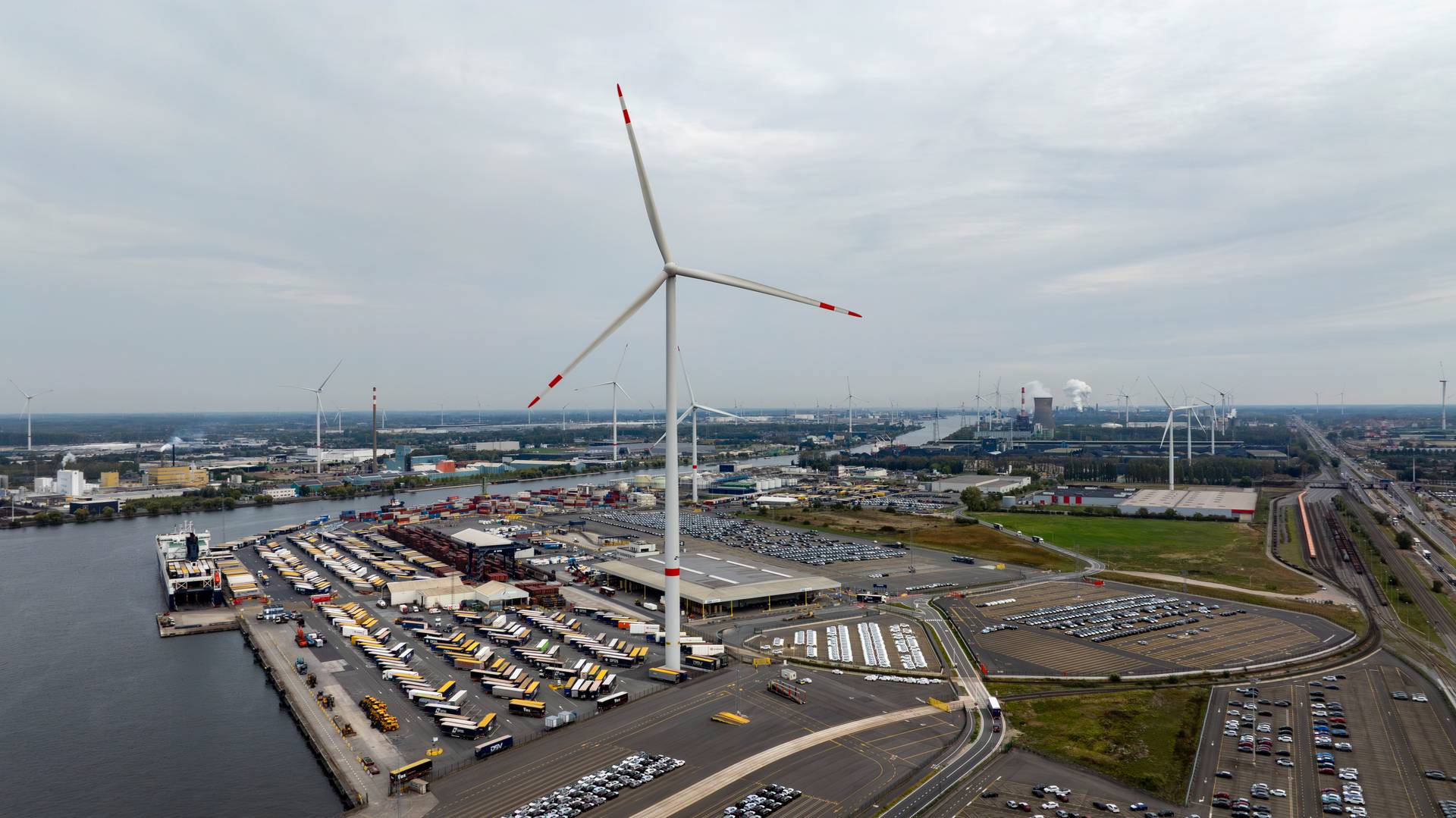
At 247 metres from base to tip, the wind turbine at Mercatordok towers high above Belgium. It now surpasses the previous record-holder near the Moervaart, making it the tallest turbine in the country. Both turbines are striking landmarks in the Port of Ghent. The largest one, at two and a half times the height of the Atomium, produces 17 million kilowatt-hours annually. Together, they generate enough green electricity for more than 9,000 households and save around 12,000 tonnes of CO₂ per year.
Tall trees are not alone in catching the wind. Turbine towers also reach for the sky. The higher the altitude, the stronger and more consistent the wind: ideal for densely populated Belgium. We ensure a solid foundation every time: from technical site and soil investigations, through the permitting process, to the design of civil and electrical infrastructure and foundations. This ensures that these wind giants operate safely and deliver maximum efficiency.

Steaming ahead on shore power
Our Flemish ports are setting a new standard for sustainable shipping. We are supporting this green shift with shore power installations that reduce carbon emissions by up to 98% and particulate emissions by up to 95%. In Ghent, river cruise vessels now moor in silence: no more diesel generators, but quiet power units that save 1.2 tons of CO₂ per ship. Over an entire cruise season, that means 500 tons less emissions.
The new jetty at Grootdok accommodates four ships and is equipped with shore power and water connections. We guide the project from A to Z: from the feasibility study to permit application, from tender dossiers to subsidy requests through the European AFIF programme. And it doesn’t stop in Ghent: in Zeebrugge and Antwerp, we also support cruise terminals with technical specifications and basic designs. Because the future of clean, quiet shipping starts on shore.


From peak pressure to tailored mobility
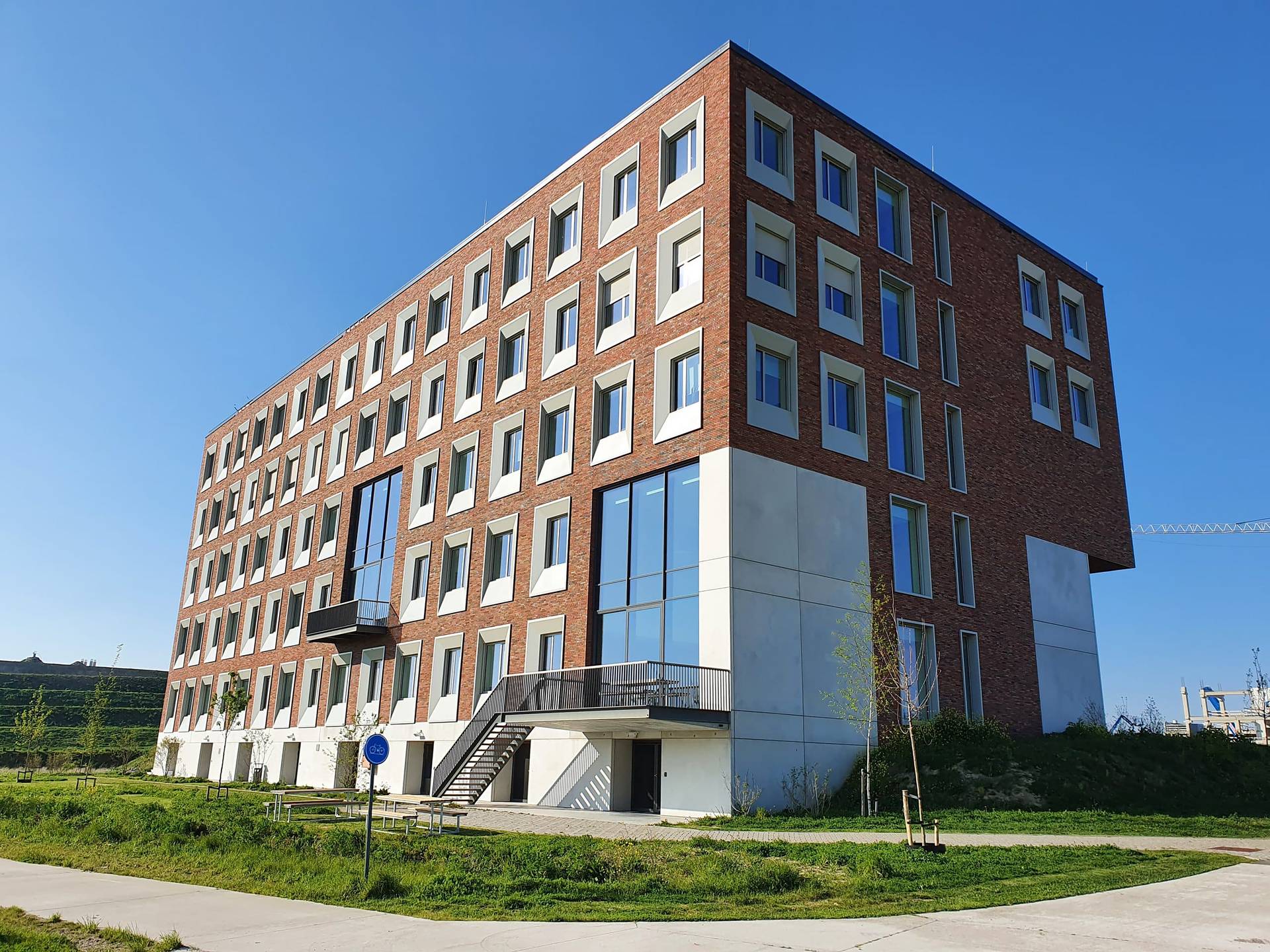
The Eiland Zwijnaarde business park is growing rapidly, but space is limited. Strategically located along the R4 and enclosed by the Upper Scheldt, Tijarm and Ringvaart, it is an ideal location for knowledge-based and water-linked companies. Today, about 1,000 people commute there; by 2030, that number will rise to 3,000, possibly even 5,000. Despite multimodal access, the car remains dominant. Traffic pressure peaks on Tuesdays and Thursdays, both on the road and on public transport. Yet a quarter of employees live less than 15 kilometres from work.
The key? Mobility management at business-park level. By dispersing travel movements and stimulating alternative mobility, together with companies and authorities, we can create real change. As mobility manager, we take on the role of neutral coordinator. We align interests, make decisions and translate plans into action. The shared goal is the driving force: connecting companies within one sustainable network.